
By Dr. Alessio Maiorino, Endocrinologist at Aventino Medical Group, Rome
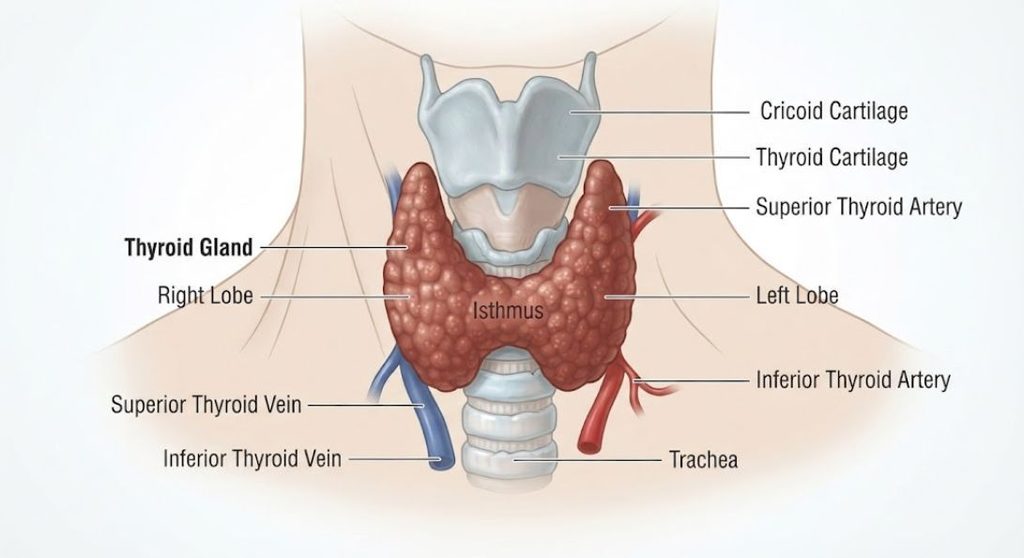
The thyroid is a small gland located in the front of the neck, yet it plays a fundamental role in the balance of the entire body. Through the production of thyroid hormones, it helps regulate metabolism, energy consumption, body temperature, heart rate, and numerous other functions.
When the thyroid is overactive, underactive, or presents structural alterations, symptoms can vary widely and—especially in the early stages—be non-specific: fatigue, weight fluctuations, palpitations, nervousness, heat or cold intolerance, mood changes, or sleep disturbances can all have multiple causes.
For this reason, when there is a clinical suspicion or risk factors are present, a thyroid check allows for the evaluation of both its function and, when indicated, its structure.
What does checking the thyroid mean?
Thyroid evaluation is not based on a single test. It generally comprises three complementary levels:
- The endocrinological consultation, during which symptoms, personal and family history, and the characteristics of the gland are evaluated.
- Blood tests, which make it possible to understand how the thyroid is functioning and, in certain cases, whether an autoimmune process is present.
- Thyroid ultrasound, which allows for studying the structure of the gland and identifying any nodules or other anatomical alterations.
It is important to understand the difference: blood tests primarily tell us how the thyroid functions, while ultrasound mainly shows us what it looks like.
A thyroid can therefore have normal hormone values yet present a nodule on ultrasound; similarly, it may be structurally little altered while functioning too much or too little.
1. The endocrinological consultation

The first step is gathering the clinical history.
The endocrinologist evaluates the potential presence of symptoms compatible with thyroid dysfunction and takes into consideration certain factors that may increase the likelihood of developing a thyroid condition.
These may include:
- Family history of thyroid diseases;
- Previous autoimmune conditions;
- Type 1 diabetes or other autoimmune diseases;
- Previous thyroid issues;
- Presence of a goiter or nodules;
- Therapies or medications that can interfere with thyroid function;
- Previous treatments or radiation to the cervical region;
- Pregnancy or particular life stages, when clinically relevant.
During the consultation, the doctor may also observe and palpate the neck region to assess the size, consistency, and regularity of the thyroid and check for any nodules or enlargements.
However, the presence of a single symptom is not sufficient to diagnose a thyroid disease: many disorders commonly attributed to the thyroid can have other causes.
2. Blood tests: what do they measure?

TSH: the main indicator of thyroid function
TSH (Thyroid Stimulating Hormone) is produced by the pituitary gland and has the task of stimulating the thyroid to produce its own hormones. It is generally the first test used to evaluate thyroid function. In simplified terms:
- An elevated TSH may suggest that the thyroid is working less than necessary;
- A low TSH may suggest that the thyroid is working excessively.
This data must nevertheless be interpreted together with the clinical picture and, when necessary, other thyroid hormones.
FT4: Free Thyroxine
FT4, or free thyroxine, represents one of the main forms of thyroid hormone present in the blood.
The combined interpretation of TSH and FT4 makes it possible to distinguish different conditions:
- High TSH + Low FT4: May be indicative of overt hypothyroidism.
- High TSH + Normal FT4: May be compatible with subclinical hypothyroidism.
- Low TSH + High FT4: May indicate overt hyperthyroidism.
- Low TSH + Normal FT4: May require further investigation with FT3 to evaluate, among other possibilities, subclinical hyperthyroidism.
In the presence of a TSH below the reference range, in fact, measuring FT3 as well may be indicated.
3. Thyroid antibodies: anti-TPO and anti-Tg
Some of the most common thyroid diseases are of autoimmune origin: the immune system produces antibodies directed against components of the gland itself.
Anti-Thyroperoxidase Antibodies – Anti-TPO
Anti-TPO antibodies are particularly useful when an autoimmune thyroid pathology is suspected.
Their positivity is frequently associated with Hashimoto’s autoimmune thyroiditis, one of the main causes of hypothyroidism.
However, they may also be present in other autoimmune thyroid conditions and, in some subjects, may test positive without a clinically manifest thyroid dysfunction being present.
Anti-Thyroglobulin Antibodies – Anti-Tg
Anti-thyroglobulin antibodies (Anti-Tg) represent a further indicator of thyroid autoimmunity and can be present especially in autoimmune thyroiditis.
In this case as well, the result must not be interpreted in isolation but alongside TSH, FT4, ultrasound, and the clinical picture.
Thyroid antibodies, therefore, are not used to diagnose thyroid cancer: their main task is to contribute to the evaluation of autoimmune pathologies.
4. Thyroid ultrasound: what does it allow us to see?
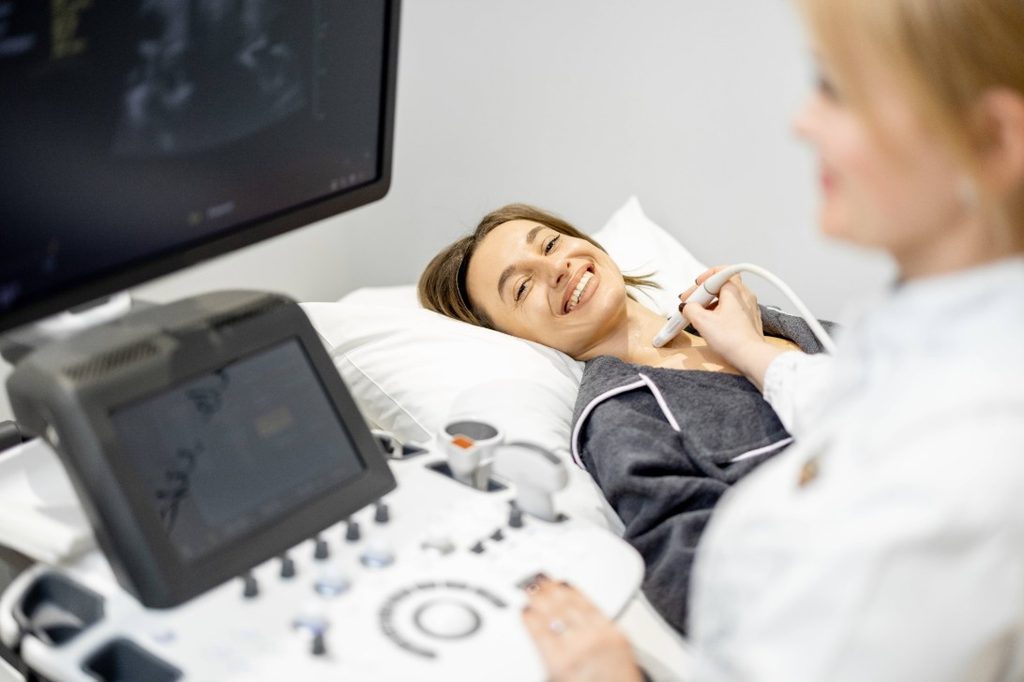
Thyroid ultrasound is a non-invasive, painless examination free of ionizing radiation.
The patient is made to lie down with the neck slightly extended. The doctor applies a small amount of gel to the skin and uses an ultrasound probe to observe the gland.
The examination makes it possible to evaluate:
- Thyroid dimensions;
- Volume of the two lobes;
- Structure and homogeneity of the tissue;
- Potential presence of nodules;
- Number and size of nodules;
- Ultrasound characteristics of the nodules;
- Presence of cysts;
- Any signs compatible with inflammatory or autoimmune processes;
- Lymph nodes of the cervical region, when necessary.
What happens if a nodule is found?
Thyroid nodules are very common, and the majority are benign.
The discovery of a nodule therefore does not mean having cancer.
However, ultrasound makes it possible to study certain characteristics, including composition, echogenicity, margins, shape, and the potential presence of calcifications or suspicious lymph nodes.
Based on ultrasound characteristics and size, the doctor can determine whether monitoring is sufficient or whether it is advisable to proceed with further checks, such as ultrasound-guided thyroid fine-needle aspiration.
What diseases can a thyroid check help detect?
The check-up can lead to the identification of very diverse conditions:
Hypothyroidism
In hypothyroidism, the thyroid produces an insufficient quantity of thyroid hormones.
It can manifest with:
- Fatigue
- Sleepiness
- Greater sensitivity to cold
- Weight gain
- Dry skin
- Intestinal slowing
- Difficulty concentrating
- Mood alterations
- Menstrual cycle irregularities
Diagnosis stems primarily from the evaluation of TSH and FT4.
There are also subclinical forms, in which TSH is altered while FT4 still remains within reference values.
Hashimoto’s Thyroiditis
Chronic autoimmune thyroiditis of Hashimoto is a disease in which the immune system reacts against the thyroid.
Over time, it can cause a progressive reduction in gland function and thus hypothyroidism.
Evaluation may include:
- TSH
- FT4
- Anti-TPO antibodies
- Potentially, anti-Tg antibodies
- Thyroid ultrasound pattern
Having positive antibodies does not necessarily mean already having hypothyroidism: function and autoimmunity are two linked yet distinct aspects.
Hyperthyroidism
In hyperthyroidism, the thyroid produces an excessive quantity of thyroid hormones.
Among possible symptoms:
- Palpitations
- Tachycardia
- Unintentional weight loss
- Nervousness or irritability
- Tremors
- Excessive sweating
- Heat intolerance
- Difficulty sleeping
- Increased bowel movement frequency
Tests may highlight reduced TSH, associated in overt forms with an increase in FT4 and/or FT3.
Graves-Basedow Disease
Graves-Basedow disease is one of the main causes of autoimmune hyperthyroidism.
When the clinical and hormonal picture suggests this possibility, specific antibodies directed against the TSH receptor, called TRAb, may be requested.
These antibodies are not necessarily part of an initial routine check-up, but are used when it is necessary to investigate the cause of hyperthyroidism.
Thyroiditis
The thyroid can also be affected by inflammatory processes of varying origins.
Some types of thyroiditis may initially provoke the release into the blood of hormones already stored in the gland, resulting in a temporary phase of thyrotoxicosis; subsequently, a phase of reduced thyroid function may appear.
The necessary investigations depend on the type of suspected thyroiditis and the clinical history.
Goiter
Goiter refers to an increase in thyroid dimensions.
It can be:
- Diffuse
- Associated with one or more nodules
- Present with normal thyroid function
- Associated with hypothyroidism
- Associated with hyperthyroidism
The combination of consultation, hormone tests, and ultrasound makes it possible to define its characteristics and establish whether further investigations are necessary.
Thyroid Nodules
A nodule is a circumscribed area of the thyroid with different characteristics compared to the surrounding tissue.
It can be:
- Solid
- Cystic
- Mixed
- Single
- Part of a multinodular thyroid
The majority of thyroid nodules are benign.
The purpose of the ultrasound is not simply to note the presence of the nodule, but to evaluate its risk profile and determine whether it needs to be monitored over time or undergo further investigations.
Thyroid Cancer
One of the purposes of evaluating a nodule is also to recognize any characteristics that require checks to rule out a thyroid neoplasm.
It is important to make a distinction, however: TSH, FT4, Anti-TPO, and Anti-Tg tests are not screening tests for thyroid carcinoma.
Many thyroid cancers, in fact, can appear in people with perfectly normal thyroid function.
When a nodule presents ultrasound characteristics considered suspicious, the endocrinologist may indicate a fine-needle aspiration with cytological examination.
Calcitonin and other markers are not necessarily requested as routine tests for any nodule, but are used in specific clinical situations.
When can checking the thyroid be useful?
It is advisable to discuss this with your doctor especially in the presence of:
- Unexplained persistent fatigue;
- Significant and unintentional weight variations;
- Palpitations or tachycardia;
- Particular sensitivity to heat or cold;
- Tremors;
- Persistent bowel habit alterations;
- Menstrual cycle alterations;
- Swelling or a visible/palpable nodule in the neck;
- Family history of thyroid pathologies;
- Presence of other autoimmune diseases;
- Previous diagnosis of a thyroid pathology.
A change in voice, difficulty swallowing or breathing, or a cervical mass rapidly increasing in volume instead require prompt medical evaluation.
Screening and diagnosis: an important distinction
In common language, people often speak of “thyroid screening” to indicate a check-up.
In medicine, however, screening means systematically subjecting people without symptoms to an exam to detect a disease early.
For thyroid dysfunction, there is currently no international consensus recommending indiscriminate, comprehensive screening of all asymptomatic adults.
Instead, the check-up takes on particular value when symptoms, clinical signs, family history, or risk factors exist, or when the doctor deems it appropriate to investigate the function or structure of the gland.
In practice: how does a thyroid check-up work?
A complete pathway can be extremely simple:
- Endocrinological consultation
The doctor gathers the clinical history, evaluates any symptoms and risk factors, and examines the thyroid region.
- Thyroid ultrasound
In a few minutes, it is possible to study the morphology, dimensions, and structure of the gland and verify the potential presence of nodules.
- Blood draw
Tests selected based on the specific case make it possible to evaluate thyroid function and, when indicated, the presence of autoimmunity.
- Comprehensive interpretation
The true value of the check-up stems from the joint interpretation of the results: symptoms, consultation, blood values, and ultrasound must not be considered separately.
Only through this comprehensive evaluation is it possible to establish whether the thyroid is healthy, whether it is advisable to perform further investigations, or whether starting monitoring or treatment is necessary.
A small check-up for a gland that influences the entire body
Thyroid pathologies can be very diverse: some concern the function of the gland, others its structure, and still others the immune system.
A targeted check allows for distinguishing these conditions and, when a clinical indication exists, recognizing alterations early that might require further study.
For this reason, thyroid evaluation should not be reduced to a single laboratory value: endocrinological consultation, blood tests, and ultrasound provide different and complementary information.

Would you like to check your thyroid health?
Before minor disorders are underestimated, a specialized endocrinological consultation helps you prevent and promptly identify any alterations.
At Aventino Medical Group in Rome, Dr. Alessio Maiorino offers you comprehensive pathways combining clinical evaluation and thyroid ultrasound with advanced technologies.
Book your specialist check-up today to protect your well-being with a personalized approach.