
By: Prof. Guido Castelli Gattinara (Pediatrician and Infectious Disease Specialist), Dr. Paola Groff (Pediatrician), Dr. Blegina Shashaj (Pediatrician), Dr. Catherine Stainier (Pediatrician).
Why read this article
If you are living in Rome with private health insurance, applying for — or not yet holding — an Italian Health Card (Tessera Sanitaria), or trying to align your children’s vaccination schedule with the Italian one, this guide will help you understand what to do, where to go, and how to request reimbursement.

Understanding the Italian Vaccination Schedule
The Lifetime Immunization Schedule – 5th Edition 2025, developed on the basis of recommendations issued by Italy’s leading scientific societies, offers a clear and practical guide to the vaccinations recommended at every stage of life. This framework is part of the institutional structure of the National Vaccination Prevention Plan (PNPV) 2023–2025, which serves as the national point of reference for vaccine policy in Italy.
The vaccination schedule is uniform throughout the country, shared between the State and the Regions, and broadly aligned with those used in other Western countries.
For adults, recommended vaccines vary according to age and clinical circumstances and may include: annual influenza vaccination, diphtheria-tetanus-pertussis (dTpa) boosters every 10 years, MMR/varicella in the absence of immunity (through previous illness or vaccination), HPV (human papillomavirus), pneumococcal vaccination, and herpes zoster vaccination for specific age groups or risk categories.
In children, the Italian vaccination schedule includes both mandatory and recommended vaccinations, according to age.
The mandatory vaccinations for children and adolescents aged 0 to 16, required for access to school communities, are:
diphtheria, tetanus, poliomyelitis, hepatitis B, pertussis, Haemophilus influenzae type b, measles, mumps, rubella and varicella.
Recommended vaccinations:
pneumococcal disease, meningococcal disease, rotavirus, human papillomavirus — depending on age — and influenza in certain situations.
Recommended vaccinations are not secondary: they are an essential part of paediatric prevention and help provide more complete protection, especially for more vulnerable children or during specific times of the year.
Seasonal COVID-19 vaccination: each year, the Ministry of Health and the Italian National Institute of Health (ISS) publish updated recommendations. For 2024–25, revised doses were issued for different age groups. It is advisable to check the priority groups and dosage recommendations every season.
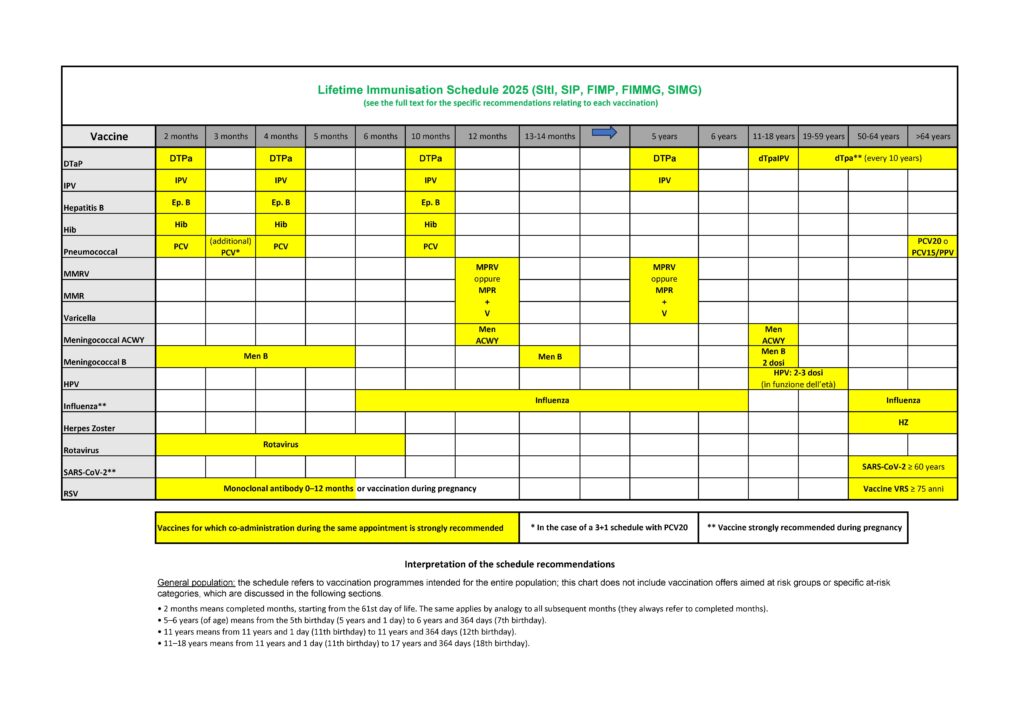
Download the 2025 Life Immunization Schedule in PDF
With or Without an Italian Health Card: What Changes?
- If you have an Italian Health Card (Tessera Sanitaria): many pediatric vaccinations are offered free of charge at your local ASL vaccination centres, according to age and the official indications in place. Adults may also have access to certain vaccinations free of charge or with co-payment, depending on age or clinical condition.
- If you do not have an Italian Health Card: you may still be vaccinated at a private clinic or medical centre, paying both the cost of the vaccine and the medical service. If you have private health insurance, you can often request reimbursement by submitting the invoice and any medical documentation required. It is always worth checking your policy conditions in advance, including any deductibles, limits, or direct billing arrangements.
Where to Get Vaccinated in Rome
- ASL (public service): if you are resident in Italy or covered by the National Health Service, you can access vaccinations through your local ASL vaccination centres. Booking procedures may vary, so it is useful to consult the website of your local ASL or the Salute Lazio portal.
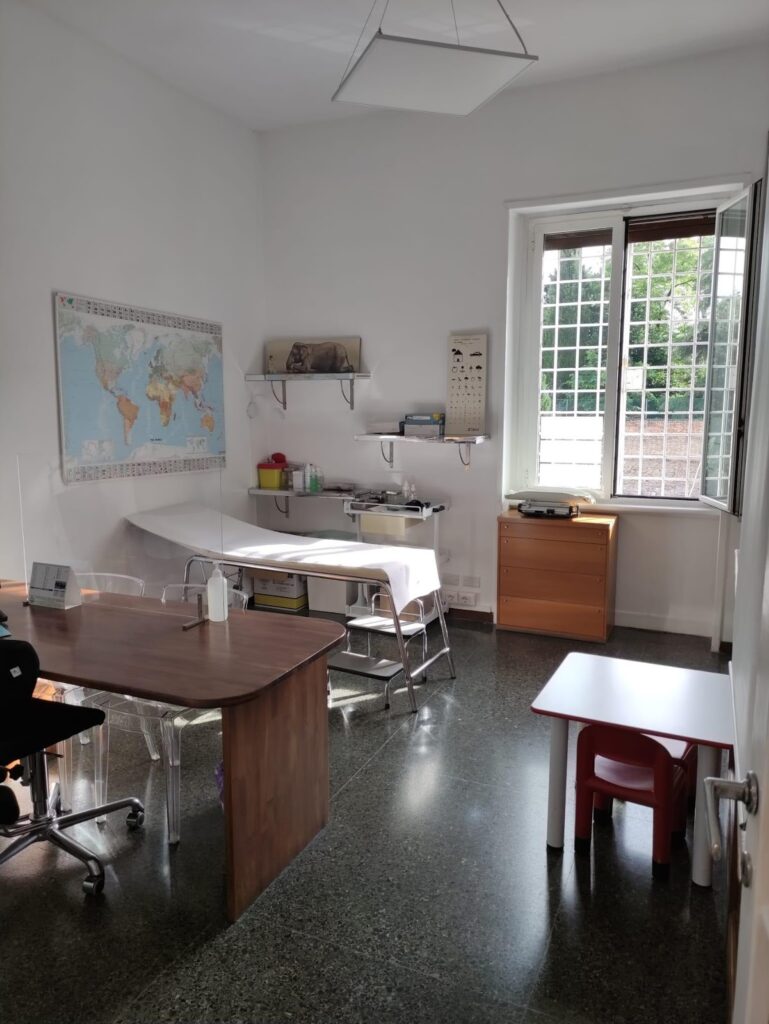
- Aventino Medical Group (private service): if you are looking for a faster, more guided and easier-to-organise pathway, especially when arriving from abroad with a different vaccination record, tight school deadlines or upcoming travel plans, our medical centre offers both pediatric and adult vaccinations. We care for children from birth onwards, including catch-up schedules for foreign vaccination records, as well as adults needing routine vaccines or vaccinations related to international travel. In the presence of specific questions, complex medical histories, uncertainty regarding immunity, or travel to higher-risk areas, an evaluation by a pediatric infectious disease specialist is also available.
Documentation: after vaccination, we provide complete documentation for school, travel, insurance, and reimbursement purposes, including the vaccine name, date, dose, site and route of administration, batch number, expiry date, physician’s signature, and official stamp.
Children: How to Align a Foreign Vaccination Schedule
If you arrive in Italy with a foreign vaccination booklet or record, it is important to always bring:
- a translation, at least into Italian, English or French, especially if the original document is written in a different alphabet (for example Arabic, Chinese or Cyrillic);
- the dates, type of vaccine, and batch numbers, if available.
Based on the documentation provided, the pediatrician or vaccinating physician can assess equivalence with the Italian schedule and, if necessary, propose a catch-up plan for any missing doses or boosters.
Please note that the Italian vaccination schedule includes 10 mandatory vaccines for children and adolescents aged 0–16 years.
RSV Immunization: What It Is and Where It Is Given
In recent years, growing attention has been paid to the prevention of Respiratory Syncytial Virus (RSV), one of the leading causes of bronchiolitis and respiratory infections in infants, especially during the first months of life.
In Italy, newborn protection may be provided through immunization with monoclonal antibodies. This is not the classic vaccine included in the routine pediatric vaccination schedule, but rather a preventive measure designed to protect newborns during the season of highest risk.
Administration usually takes place in hospital, often in the maternity unit before discharge. In other cases, it may be arranged by the family pediatrician, where available, or by the local ASL vaccination centres.

Adults: Which Vaccines Should Be Considered?
The vaccinations most frequently considered in adulthood include:
- Influenza: recommended every year, especially during autumn and winter, with particular attention to more vulnerable individuals and older age groups.
- dTpa (diphtheria-tetanus-pertussis): booster every 10 years; also recommended during pregnancy, generally in the third trimester.
- MMR and varicella: to be assessed in the absence of immunity or in the case of uncertain vaccination history.
- HPV (human papillomavirus): especially recommended in younger age groups, with the possibility of individual assessment even beyond those ages.
- Pneumococcal and herpes zoster vaccines: recommended in older adults or in the presence of specific risk factors.
Other vaccinations may be indicated depending on personal circumstances, individual risk factors, or epidemic outbreaks, such as meningococcal ACWY or meningococcal B vaccination.
Recommendations may vary according to age, medical history, pregnancy, occupation, travel plans, and the presence of chronic diseases: this is why a personalised medical assessment is always useful.
For seasonal COVID-19 vaccination, updated recommendations should be checked every year.
Vaccinations Before Travelling Abroad
For some international trips, it may be important to check in advance whether specific boosters or vaccinations are needed, depending on the destination, type of stay, and personal circumstances. In some cases, vaccines are recommended; in others, they may be required for entry into the destination country. A dedicated blog article on this topic will be published shortly.
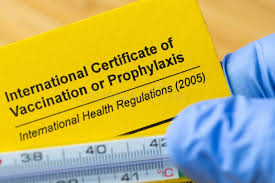
School Requirements and Vaccination Documents
For nursery, preschool and primary school, vaccination certificates, self-declarations or official proof of vaccination may be required. If some mandatory doses are missing, a catch-up plan may be requested within an agreed timeframe.
It is always advisable to ask the school directly which documents are required and, if needed, contact the ASL or the doctor who administered the vaccinations in order to obtain the correct paperwork.
Private Health Insurance: How to Request Reimbursement
If you have private health insurance, it may be useful to check in advance:
- whether the vaccination is reimbursable;
- whether your policy includes deductibles, reimbursement caps or limitations.
Always keep the invoice and all available medical documentation. Some insurers also require a prescription, a clinical indication or a medical certificate; others reimburse only the cost of the vaccine and not the medical service itself.
Frequently Asked Questions
I do not have an Italian Health Card: can I still be vaccinated?
Yes. You can be vaccinated at a private medical facility, with direct payment and possible reimbursement from your insurance afterwards.
I was vaccinated abroad: are those vaccines valid in Italy?
Yes, provided they are properly documented. The physician will assess the equivalence of the products used and any boosters required according to the Italian PNPV.
Useful Official Links
- Vaccination Schedule & PNPV 2023–2025 – Ministry of Health / ISS
- Lifetime Immunization Schedule, 5th Edition 2025
- COVID-19 Recommendations 2024/25 – ISS / Epicentro
- Salute Lazio Portal – Vaccinations / healthcare services
📍 Do you need to align a foreign vaccination schedule, plan booster doses, or organise vaccinations before travelling?
Book an assessment at Aventino Medical Group.
We help you define a clear, personalised vaccination pathway for both children and adults, and provide the documentation needed for school, work, insurance, and reimbursement requests.