
Following the full-scale Russian invasion of Ukraine, psychoanalysts across Europe organized volunteer initiatives to support colleagues, patients, and families affected by the war. One such initiative was an online mothers’ group facilitated by the author. This article brings together excerpts from the testimonies of two Ukrainian psychoanalytic psychotherapists and mothers who participated in the group. The excerpts have been edited and rearranged while preserving the authors’ original words.
The full version of this article is published in ‘Child and Adolescent Psychoanalysis in Times of Crisis War, Pandemic and Climate Change’, edited by Kristin. Fiorella and published by Routledge in 2025.
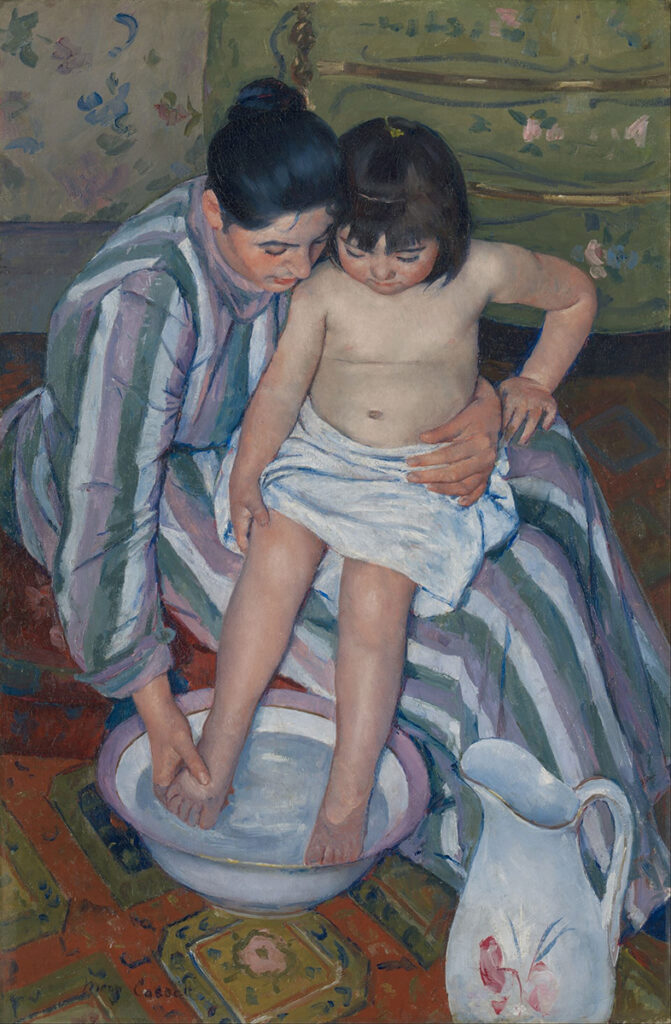
Mary Cassatt (1844–1926), The Child’s Bath, 1893. Olio su tela.
The Beginning
KATERYNA
Before the war started, I lived comfortably in my country and had a private psychotherapy practice. Together with my beloved husband, we were raising our son, had bought a house and were planning to renovate it in preparation for the arrival of our daughter.
I never planned to emigrate when I was eight months pregnant. I could not even imagine in my worst nightmares that I would give birth under the explosions of enemy rockets and that our first days with our daughter would take place in a bomb shelter. I could not imagine that my fear of death would become so real that it would manifest itself in a desire to hold my daughter constantly, even when there was no need or threat.
TETIANA
The war took us by surprise. But I was already familiar with the first powerful explosions I heard at five in the morning on 24 February. My heart was pounding, and tears were streaming down my face. I felt a sticky, hot déjà vu from the summer of 2014 in Donetsk. For a moment I was immersed in memories of a wonderful family and peaceful life. Then, with the Russian invasion, I lost everything at once. I could not believe that the situation was repeating itself. My heart cried out in denial, but reality broke into my consciousness with terrible explosions from all sides.
In the first days of the war, when I was full of despair and fear, my six-month-old son did not seem to react at all to the events around him. He remained as cheerful and lively as ever.
One moment stands out in my memory. Almost at midnight, a powerful bombardment began and everything around us exploded loudly. We took the children to the stairwell next to the lift and just stood there, trembling from the sound of the deadly shells. I held the baby in my arms and tried to talk to him, and he babbled back, looked into my eyes and smiled. At that moment, a wild fear for my children’s lives overwhelmed me. At the same time, I was relieved that my baby was fine and did not seem frightened at all.
Birth
KATERYNA
The war caught me at the beginning of my eighth month of pregnancy. I refused to even think about giving birth in a cellar or a bomb shelter. Photographs of the first women giving birth in underground and metro shelters horrified me. I could not believe in this reality or that I would have to face it directly.
I dreamed that my child would be born in my hometown, accompanied by a doctor I trusted and in partnership with my husband. I imagined that we would return home with our daughter to our son and gradually get used to our new family member. I felt that all the conditions were in place to give this child a basic sense of security and safety in the world I would be bringing her into.
A woman enters the maternity ward with one identity and leaves with another.
But in the harsh reality of war, with constant sirens and being in a bomb shelter with a newborn in my arms, this space was transformed into something damaged, further increasing my regression and fears.
I was lucky. Our first meeting with my daughter was in the delivery room, not the bomb shelter, and we managed to enjoy the silence in each other’s strong embrace for the first hour and a half.
But soon the chaos began and the siren went off. Shortly afterwards we heard that two cruise missiles had fallen near the maternity hospital. That day, my daughter and I spent time in the corridor and in the bomb shelter. Tears streamed uncontrollably down my face.
Inside me and around me echoed the question:
“When will this nightmare end?”
TETIANA
Almost a year later, after we had reached safety, the neighbors started setting off fireworks. Suddenly my son started screaming, grabbed his clothes and pulled me down the stairs.
It struck me that he seemed to be experiencing the same thing I had experienced when I held him to my heart to the sound of cannon fire. When he slept, he would cling to my neck as if to prevent me from falling if I suddenly had to run somewhere. I also felt much calmer having him close. In this way I felt I could protect him better, shielding him with my body in case of danger.
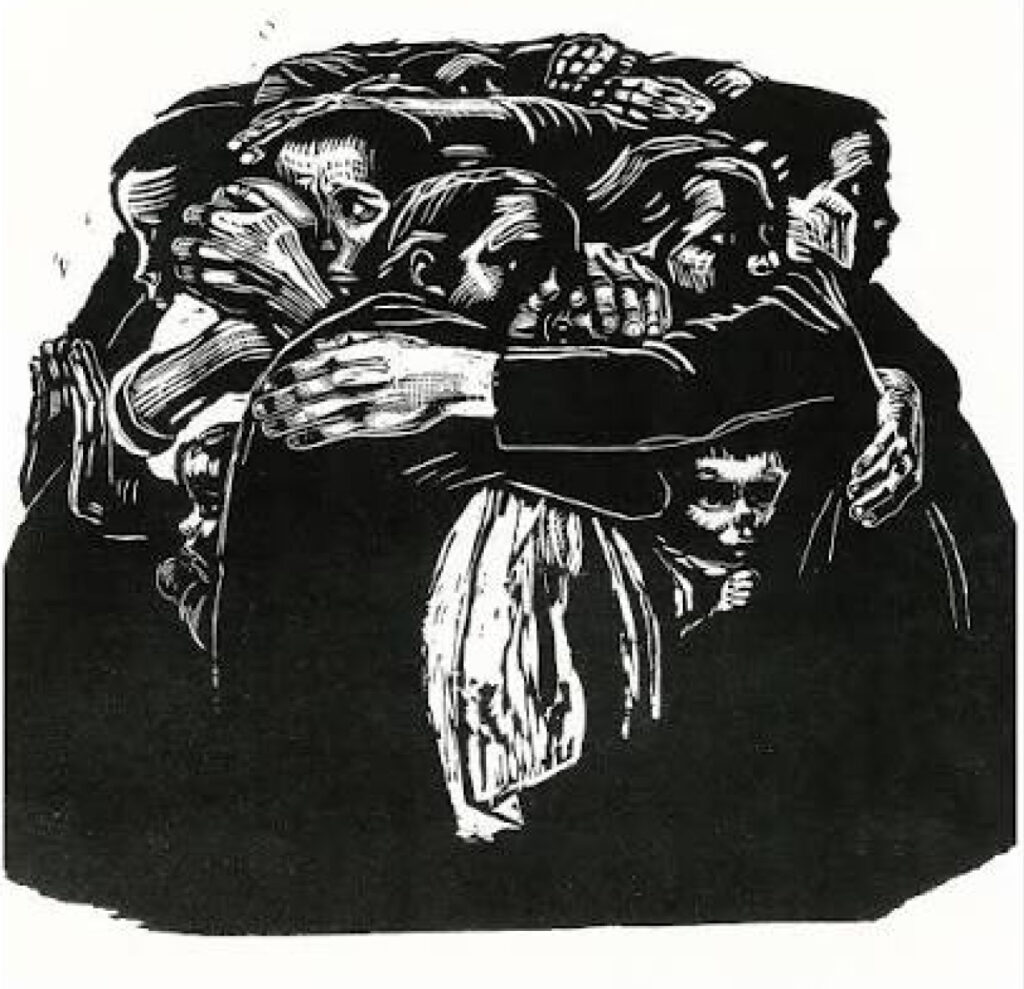
Käthe Kollwitz (1867–1945), Die Mütter (Le Madri), 1921–1922. Xilografia.
Leaving
TETIANA
I had fled Donetsk under fire with two children, and now I had a newborn with winter outside.
For the first few days I was in a state of utter shock and helplessness, with an almost animal fear for my children’s lives. Somewhere around the fifth day, after another terrifying night in a cold basement with a screaming baby, I realized that I had to secure a safe place for all of us. If something happened to me, who would look after them?
My emotions ranged from helplessness to inner strength and determination. The fear of danger on the road for my baby was extremely heavy for me, but staying was much more dangerous.
We were very lucky to reach the station, board a train to Lviv and finally leave the country. The arduous journey took more than four days. Due to the intense stress, we all became seriously ill, especially the little one. But the most important thing was that we were finally safe.
KATERYNA
When we finally left Ukraine, I realised that leaving did not mean that the war was over. I carried it with me. I remained hypervigilant. I wanted to keep my daughter close all the time, even when there was no objective danger. I understood that this was my own fear rather than hers, but understanding it did not make it disappear.
Sometimes I wondered what she would remember of those first weeks of life. Would the sounds of sirens remain somewhere inside her? Would my fear become part of her earliest experience of the world? These questions stayed with me long after we had reached physical safety.
Now I am a forced migrant, a refugee.
What is left of my former life?
What have I lost forever?
What can I do?
Who am I here?
What’s next?
These and many other questions swirl around in my mind. I often feel emotionally overwhelmed, anxious and exhausted.
The Group
TETIANA
At the beginning of the war we left the country with our children. In conditions of total uncertainty about the future and in a new, unfamiliar environment, I acutely felt the lack of “my own”—people with similar experiences with whom I could share my feelings.
The group became an essential space for me to share my feelings and to give and receive mutual support during these incredibly challenging times. Communicating with other mothers gave me the understanding I so desperately needed. We were all experiencing similar fears, anxieties and hopes, and this created a sense of community that helped us cope with the emotional burden.
When I joined the mothers’ group, I discovered that I was no longer alone with these experiences. Listening to other women, I recognised feelings that I had believed belonged only to me. We could speak about our fear, our guilt, our helplessness and our children without having to explain why these feelings existed. Everyone already knew.
The meetings became a place where unbearable emotions could be shared instead of carried in isolation.
KATERYNA
For me, too, the group became a place where I could breathe again. It did not change the external reality. The war continued. We remained separated from our homes, our work and many of the people we loved. But the meetings helped me recover the capacity to think.
Listening to the other mothers reminded me that, despite everything, we were still mothers, still psychotherapists and still capable of reflecting on our children’s inner worlds as well as our own.
Today
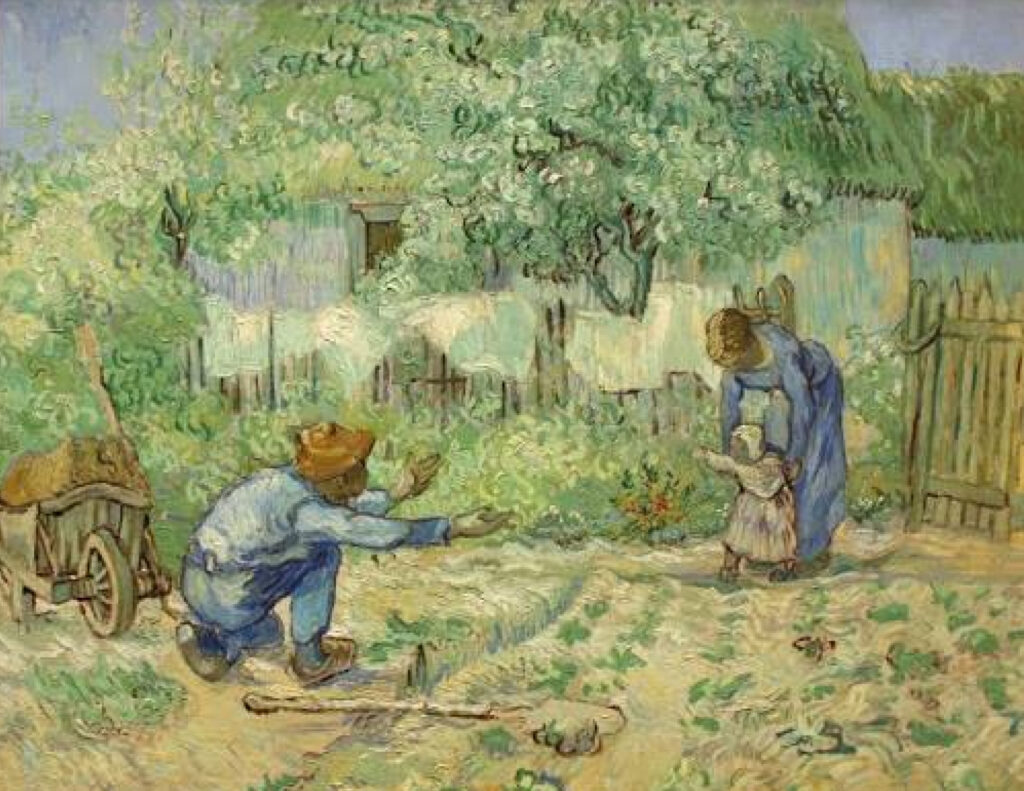
Vincent van Gogh (1853–1890), First Steps (after Millet), 1890. Olio su tela.
TETIANA
The other day I was reading a bedtime story to my son. The illustration for the Ukrainian folk tale Ivasik-Telesyk showed a multi-headed dragon trying to reach the boy Ivasik, who was hiding in a tree. When Sasha saw this, his eyes sparkled with determination. He immediately held out his hand, shouted, “Sasha is a tank!” and began to imitate the sound of gunfire. In his childlike simplicity, he was trying to save Ivasik from destruction.
This reaction touched me deeply. I had never seen my son, who has no toy guns, react emotionally to a situation like that. He simply adores technology—machines, buses, excavators, tractors and combines. His favorite game is to imitate an excavator.
Alongside the all-encompassing, unspeakable emptiness that exists within me as a result of the trauma of war, new shoots of hope and strength are emerging. I try to find light in the simple moments of joy that a child’s imagination provides. And this light, though fragile, becomes my support, my inspiration.
KATERYNA
Our little daughter is now two years and eight months old. How quickly time flies. It seems like only yesterday that I was thinking about when to introduce solid food, how to get her to sleep at night, or how to wean her from breastfeeding. Now she makes me an omelet for breakfast, chooses her own clothes for a walk, dances and sings, and says she doesn’t want to sleep but wants to go out with her friend.
She has so much tenderness, love, energy and curiosity. It is a real miracle. It is a true joy to watch my daughter grow, learn new skills almost every day, and enjoy our bond.
I was very worried that my daughter would become suspicious of the world and of other people. But now I see her interest in the things around her, her desire to communicate, and her persistent attempts to connect with other children and adults. This gives me hope and confidence.
Now I have the opportunity to meet online twice a week with women, my colleagues, who also gave birth during the war. This is a treasure that cannot be overestimated.
We are all different, but what unites us is a thirst for life, resilience and love. Our children are full participants in the group and recognize each other every time they appear on the screen. As it turns out, our children made online friends before they learned to use the potty.
We don’t always understand each other, and we don’t know how long this group will last. Nevertheless, it is a feminine space that contains and transforms unbearable feelings. We share the joys of motherhood and the successes and struggles of our children’s development.
Emanuela Quagliata
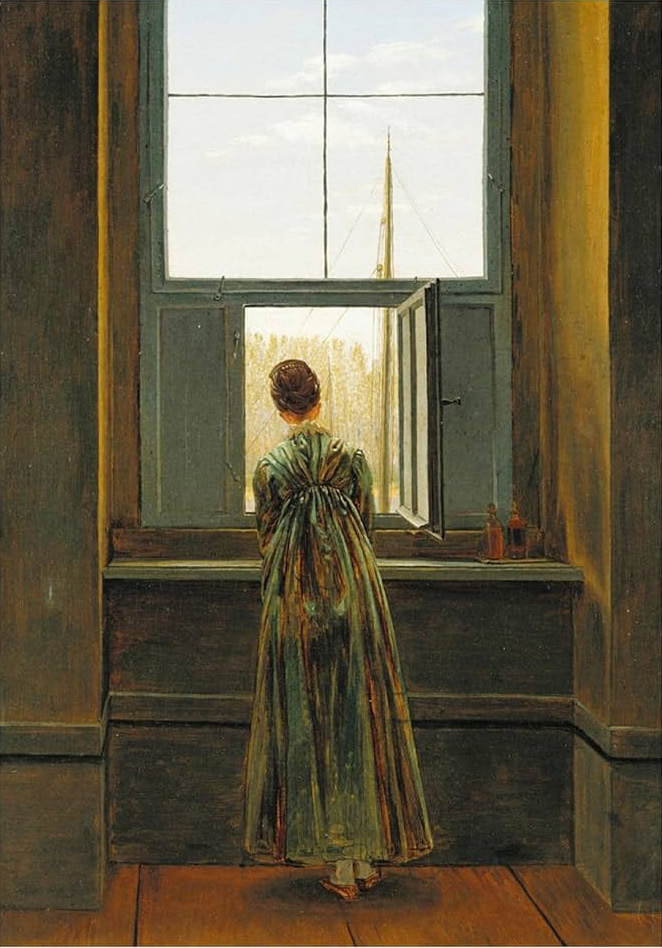
Caspar David Friedrich (1774–1840), Woman at a Window, 1822. Olio su tela.